Christmas food in Normandy is where France’s festive traditions meet a region that already takes apples, cream, cheese, seafood and Calvados extremely seriously.
Living here has taught me that Christmas dinner is less about one compulsory menu and more about taking a very long meal seriously. There may be oysters, scallops, foie gras, turkey or capon, cheese, dessert, coffee and then something alcoholic to help everyone contemplate the amount they have just eaten. France has never been especially interested in the concept of “just a light lunch”. 🎄🍽️
This guide looks at the foods, drinks and traditions you may come across at Christmas in Normandy, including Réveillon de Noël, Kir Normand, Trou Normand, Bûche de Noël and a few older Norman customs that are wonderfully specific and occasionally slightly bonkers.
If you are looking for Christmas markets, lights and festive events rather than food and traditions, see our Christmas in Normandy: Markets, Lights & Cosy Escapes. For December weather, beaches and day trips, see our Normandy in December guide.
🎄 What Do People Eat for Christmas in Normandy?
There is no single compulsory Normandy Christmas menu, but festive meals often combine wider French traditions with very local ingredients: seafood from the coast, cider and Calvados, apples, cream and Normandy cheeses. Réveillon de Noël is where all of this tends to become gloriously excessive.
🍽️ Le Réveillon de Noël – The Christmas Eve Feast
For many French families, Christmas Eve centres on le Réveillon de Noël: a long festive meal shared with family or friends on 24 December. Other families celebrate more on Christmas Day, so there is no single compulsory national timetable, but Réveillon remains one of the defining food traditions of Christmas in France.
In Normandy, that national tradition naturally picks up local ingredients: oysters, scallops, cider, apples, cream, Camembert, Calvados and Pommeau all have a habit of finding their way onto the table somewhere.
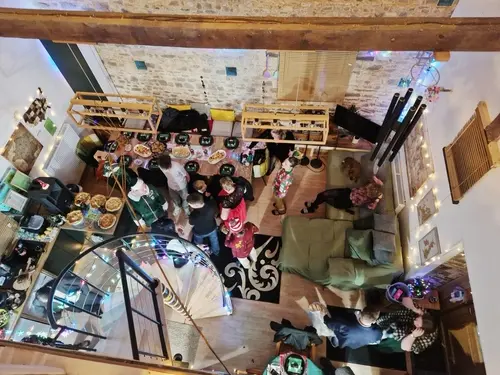
We have actually hosted Réveillon de Noël in Ursula Gîte ourselves, with French friends joining us for Christmas Eve. There were 26 of us in total, which is considerably more than the gîte's normal 8–10 guest capacity, so this should not be taken as a new occupancy recommendation. 😄
With a bit of creative furniture planning and the outdoor dining table temporarily promoted to indoor Christmas duty, we managed to seat everyone. It was definitely a squeeze, but we were among friends, which makes personal space a slightly more theoretical concept by dessert. 🎄🍽️
🍸 L’Apéritif
The meal begins with an apéro normand – a drink and nibbles before dinner. In Normandy, this might be a chilled glass of Normandy cider or Kir Normand (recipe below), served with savoury bites like cheese cubes, smoked sausage or puff pastry twists. You might also find mulled cider or hot spiced apple juice – a regional take on vin chaud (mulled wine).
🥂 Normandy Recipe: Kir Normand
Kir Normand is Normandy’s apple-based relative of the classic French Kir. Where a traditional Kir uses white wine and crème de cassis, the Norman version brings cider and Calvados into proceedings, because apparently an ordinary aperitif was not sufficiently apple-based.
Ingredients for 1 person:
- 20 ml / 2 cl crème de cassis, or another red-fruit liqueur
- 20 ml / 2 cl Calvados
- 150 ml / 15 cl Normandy cider
Method:
- Pour the crème de cassis and Calvados into a glass.
- Top up with chilled Normandy cider.
- Stir gently.
- Add an apple twist if you are feeling decorative.
- Serve well chilled.
Tip: sitting down is not strictly part of the recipe, but after the cider, cassis and Calvados have introduced themselves to one another, it is not a terrible idea. 🥂
🥂 L’Entrée – What Do the French Eat as a Christmas Starter?
French Christmas starters vary enormously by family and region. Foie gras, smoked salmon, escargots and verrines are France-wide festive favourites rather than specifically Norman dishes. In Normandy, however, seafood gives the starter course a very local advantage.
- 🦪 Oysters (huîtres) – served raw with lemon, shallot vinegar or simply on their own. On the west coast of La Manche, oysters are very much local rather than merely festive.
- Foie gras – served in slices, often with toast and fig or onion chutney.
- Escargots à la Bourguignonne – snails baked with garlic and parsley butter; French rather than Norman, but commonly found on festive menus.
- Smoked salmon (saumon fumé) – often served with blinis, lemon or herbed cream.
- Verrines – small layered starters served in glasses, ranging from goat’s cheese and vegetables to seafood or foie gras combinations.
- 🐚 Coquilles Saint-Jacques – particularly relevant here because Normandy is major scallop country. Around Granville, scallops are not an exotic festive ingredient; they are part of the local winter seafood season.
Here in La Manche, that seafood connection is very real rather than decorative menu language. Granville is a major fishing port, while the west coast around Blainville-sur-Mer and Gouville-sur-Mer is known for oysters and bouchot mussels. Christmas seafood here is very much local food, not something that has travelled halfway across France wearing a festive label. 🦪
For anyone arriving from Britain, the amount of seafood appearing before the main course can initially feel less like a starter and more like a catering misunderstanding. It is not. There is still poultry coming.
🍗 Le Plat Principal – The Main Course
The main course depends heavily on family tradition. Turkey with chestnuts, roast capon and duck are all common French festive choices, but there is no official Christmas poultry police checking what arrives at the table.
- Dinde aux marrons – turkey with chestnuts, sometimes with sausage or apple stuffing
- Confit de canard – slow-cooked duck leg
- Chapon rôti – roast capon, often served with herbs, chestnuts or apples
Side dishes might include gratin dauphinois, glazed carrots, sautéed mushrooms, green beans almondine and creamed spinach. Normandy’s apples also have a habit of wandering into sauces, stuffing and accompaniments whenever nobody is looking. 🍎
🍏 Le Trou Normand
Between courses comes one of the most recognisably Norman traditions of the meal: the Trou Normand.
Traditionally this meant a small glass of Calvados taken between courses. These days you will also often see Calvados served with apple or pear sorbet, creating a colder, fruitier version of the same tradition. Normandy Tourisme notes that the custom has spread well beyond Normandy while keeping its regional name.
The old explanation was that it created a little “hole” in the stomach so you could continue eating. Modern digestive science may have some questions about this theory, but Christmas dinner has never been a peer-reviewed exercise.
There is even an organisation devoted to protecting and promoting the Trou Normand and Normandy’s cider-based drinks. Suffice to say, the Normans have not approached this subject casually. 🍏🥃
🍧 Normandy Recipe: How We Serve a Trou Normand
The traditional version can be as simple as a small glass of Calvados. A very common modern version adds sorbet, and that is the one we prefer.
Method:
- Add a scoop of apple sorbet to a small glass.
- Pour a little Calvados over it.
- Serve between courses.
We always use apple sorbet because, frankly, once Normandy has committed this heavily to apples it seems rude to introduce pineapple at the crucial moment. 🍏
🧀 Le Fromage – Because Apparently We Are Not Finished Yet
Cheese traditionally comes after the main course and before dessert. A French cheeseboard may include goat’s cheese, blue cheese, a soft cheese, something firm such as Comté and perhaps a fresh cheese.
In Normandy, Camembert is the obvious local candidate, but it is not alone. Livarot is a washed-rind cheese from the Pays d’Auge, Pont-l’Évêque is another soft cow’s-milk cheese from the same broad part of Normandy, and Neufchâtel from Seine-Maritime is famous for its heart-shaped form. At this stage of the meal nobody is pretending there will not also be dessert.
At this point in a French festive meal, the sensible response would probably be to stop eating. The traditional response is cheese.
If you want more on Normandy’s most famous cheese, see our Camembert guide.
🍰 Le Dessert – Bûche de Noël & Norman Sweets
The classic French Christmas dessert is the Bûche de Noël: a rolled sponge or pâtisserie-style dessert shaped to resemble a log, traditionally filled with flavours such as chocolate, coffee or chestnut.
The log shape has a much older origin. In Normandy, a large Christmas log was traditionally known as a chuquet or souque and was burned in the hearth over the festive period. The edible version is considerably easier to fit in a fridge and produces fewer chimney-related administrative issues. 🔥🍰
Other desserts you may see include Paris-Brest, a choux ring filled with praline cream, and Tarte Normande, an apple tart usually enriched with cream or almonds.
☕ Coffee, Tisanes & Digestifs
After dessert comes coffee or a tisane, often accompanied by chocolates or festive sweets, because apparently dessert can have an encore.
A digestif may follow too. In Normandy, Calvados is the obvious local eau-de-vie, while Pommeau de Normandie is another apple-based drink you will often encounter. At this point the meal has become less an event and more a long-term tenancy of the dining table. ☕🥃
🥦 What Can Vegetarians Eat at Christmas in France?
Traditional French festive menus can be very meat and seafood-heavy, but a vegetarian Christmas in Normandy is entirely possible. I am vegetarian myself, so this is not theoretical research conducted while staring mournfully at a turkey.
Good festive options include potimarron velouté, mushroom risotto, nut roasts, roasted root vegetables, gratin dauphinois, baked Camembert with herbs and garlic, goat’s cheese dishes, chestnuts and plenty of Normandy cheese.
The useful thing about staying at Ursula Gîte is that guests have a properly equipped kitchen rather than the holiday-rental interpretation of one, where three people are expected to cook Christmas dinner using a saucepan the size of a mug and a knife last sharpened during the Chirac presidency.
Vegans need a little more forward planning because butter, cream, eggs and cheese appear enthusiastically in French festive cooking, but supermarkets and larger shops now carry far more plant-based options than they once did.
🎁 Old Christmas Traditions in Normandy
Normandy has some older festive customs that are far more interesting than pretending everyone has always celebrated Christmas exactly as they do now.
- 👞 The chabotée de Noël – in an older Norman tradition, children received apples, oranges and sweets in their wooden sabots, sometimes called chabots locally. Think Christmas stocking, but considerably more agricultural footwear. This is a historical custom rather than something every Norman child still does today.
- 🐇 Haguignettes or aguignettes – small puff-pastry figures, often shaped like animals, associated particularly with New Year in Normandy and especially the Pays de Caux. Historically, children went from door to door asking for gifts or food around the New Year period.
- 🔥 The chuquet – the enormous Christmas log traditionally burned in the Norman hearth. The modern Bûche de Noël is the much more manageable edible descendant of the wider French log tradition.
- 🍎 Hot cider and spiced apple juice – much more immediately recognisable to modern visitors, particularly at winter and Christmas events.
I rather like the fact that Norman Christmas history manages to involve pastry animals, wooden shoes, enormous logs and enough apple products to provision a small republic. It feels entirely on brand for the region. 🎄
🎄 Christmas in Normandy Is More Than the Meal
Food is a huge part of Christmas here, but it sits alongside markets, church concerts, lights, village events and family gatherings.
I am deliberately not repeating all of those here because we have a separate guide to Christmas markets, lights and festive events in Normandy. That is where you will find Coutances, Granville, Hambye Abbey, Haras National de Saint-Lô, Dangy and the other festive places we actually visit.
For current dates, we also update our What’s On in Normandy page as events are announced.
🇬🇧 A Taste of Our Christmas – Join Us for Christmas Day at La Ruche
Guests staying at Ursula Gîte over Christmas can book an optional Christmas Day experience that is rather more personal than having a meal delivered to the gîte.
On 25 December, guests can choose to join us at La Ruche for our own Christmas Day dinner. You are joining our Christmas table for the day, rather than ordering a separate holiday meal, which makes it feel much more like sharing Christmas with us than booking catering.
It is a traditional English-style Christmas dinner with all the usual favourites, and vegetarian or vegan options can be included with advance notice. I am vegetarian and Lee is not, so mixed menus are very much normal territory in this house. 🎄🍽️
This Christmas Day meal is available for a maximum of 6 guests and costs €65 per person. It is offered on 25 December only and must be arranged in advance so we can plan the meal properly and, more importantly, calculate the roast potato situation with the seriousness it deserves.
If you are staying at Ursula Gîte over Christmas and would like to join us at La Ruche for Christmas dinner, add it when you enquire or contact us after booking. With only 6 guest places at our table, this is one festive extra that genuinely is limited. 🎄
Book Ursula Gîte for Christmas
Our own Christmas table has inevitably become a mixture of the two countries. I am perfectly happy adopting Normandy cheese, apple desserts and a Trou Normand, but I draw the line at anything that threatens the roast potatoes and Yorkshire puddings. Cultural integration has boundaries.
🏡 Why Ursula Gîte Works Well for Christmas Food Lovers
If food is part of the reason you travel, self-catering at Christmas has a fairly obvious advantage: you can actually buy what you see at the markets and cook it.
Ursula Gîte has a properly equipped kitchen because I cook myself and know how irritating it is when a holiday kitchen looks impressive until you discover there is nothing capable of chopping an onion.
Coutances is about five minutes away for supermarkets, bakeries, butchers and the weekly market, while Granville and the west coast put seafood within easy reach. You can bring home oysters, scallops, cheese, cider, vegetables or pastries and build your own Christmas meal rather than being tied to a restaurant menu every night.
The gîte sleeps up to 8–10 people, so it also works for families and groups cooking together. The ground-floor bedroom and accessible shower room can help with multigenerational stays, and the private hot tub is useful when the person responsible for Christmas dinner has finally escaped the kitchen. ♨️🎄
And if you would rather not cook on Christmas Day itself, up to 6 guests can book to join Lee and me for our Christmas dinner at La Ruche next door. It means you can enjoy a proper Christmas Day meal without having to spend the day cooking in Ursula, while still having the gîte kitchen for your own breakfasts, snacks and meals throughout the rest of your stay.
Who Does Christmas in Normandy Suit?
It suits food lovers, families, couples and groups who enjoy cooking, markets, regional produce and long meals more than highly programmed Christmas entertainment.
It is particularly good for travellers who like discovering local ingredients and traditions rather than simply reproducing exactly the same Christmas they have at home.
It is less suitable if your ideal festive break involves eating every meal out without checking opening hours. Christmas Day in rural France is not the moment to discover that optimism is not a restaurant reservation.
🌟 So, What Is Christmas Food in Normandy Really Like?
It is generous, drawn-out, apple-heavy and remarkably unconcerned with the idea that one dessert should necessarily mean the meal is finished.
Some of the dishes are French Christmas traditions found all over the country; others, such as the Trou Normand, Calvados, cider, Camembert and the old chuquet tradition, root the meal firmly in Normandy.
What I like most is that the old and new sit quite happily together. You can read about children receiving oranges in wooden sabots centuries ago, buy oysters from the west coast today, serve apple sorbet with Calvados between courses and then finish with a chocolate log because apparently the original enormous burning one was insufficiently edible.
For us, Christmas here has gradually become a mixture of British habits and Norman ones, which is probably exactly how traditions are supposed to work. Keep the bits you love, acquire a few more, and make sure somebody remembered the cheese. 🧀🎄
Check Christmas availability at Ursula Gîte
For festive markets and lights, see our Christmas in Normandy markets and events guide. For the wider December picture, including weather, beaches and day trips, see our Normandy in December guide.