
The Witch Bottle Hidden in the Walls of La Ruche 🕯️🧹
✔ Witch bottle hidden behind a fireplace · ✔ Found inside our 1730s Normandy home
✔ Why it was concealed · ✔ Witchcraft, folklore & strange local history
Home · Availability · Book Now · Contact Us · Location · Reviews
First published: June 2025
Last Updated: September 2026
When we were renovating La Ruche, our main house next to Ursula Gîte, we already knew we were dealing with an old building: the house dates back to the 1730s. We expected the usual discoveries that come with nearly three centuries of rural life — dusty beams, old nails, reused stone and the occasional object whose original purpose had long since gone missing.
But what we didn’t expect was a witch bottle — a small glass vessel hidden deep behind the fireplace in what is now one of our guest bedrooms! 🧱✨
It wasn’t broken, but it was completely empty — no pins, no nails, no herbs. Just quietly hidden away, apparently undisturbed until our renovation. Its deliberate placement behind the hearth immediately caught our attention. Why would someone carefully conceal an unmarked bottle in the walls of their home? The answer leads into centuries-old traditions of protective magic, witchcraft belief and folk practice in Normandy.
How Do We Know It Is a Witch Bottle?
The strongest clue is the bottle itself.
Its narrow, elongated shape, small size and deliberate concealment behind the fireplace are all characteristic of bottles used as protective objects in historic buildings. This was not a modern bottle wedged accidentally into a wall cavity. Somebody placed it there, out of sight, beside the hearth.
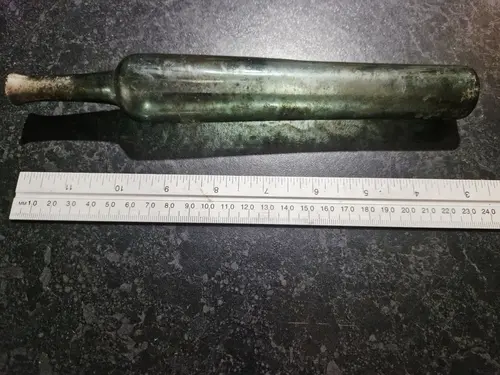
Ours measures around 25 centimeters long, with a neck roughly an 2.5 centimeters and a body no more than about 6.5 centimeters across. That unusual form matters because witch bottles were not simply any old bottle somebody happened to bury or brick up.
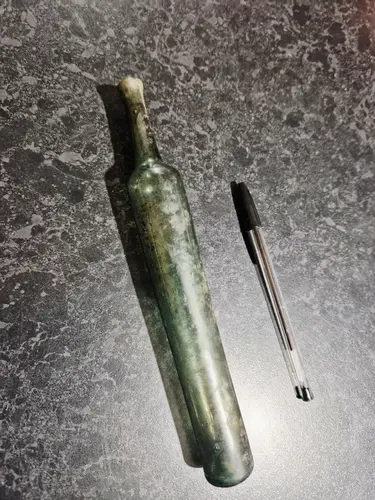
It is, in other words, rather more specialised-looking than the sort of bottle somebody casually finished with dinner and shoved behind the masonry.
The fact that ours was empty when we found it does leave one unanswered question. It may once have contained material that has disappeared, been removed or decayed, or it may have been concealed empty. Unfortunately, whoever put it there failed to leave explanatory paperwork. 🧙♀️
What we can say with confidence is that the bottle's form, size and position fit the tradition of concealed protective bottles remarkably well.
What Is a Witch Bottle? 🧪🔮
A “witch bottle” is the modern name commonly given to a deliberately concealed vessel believed to have been used as protection against witchcraft or harmful magic.
The best-documented examples date particularly from the 17th century onwards. Some contained bent pins, nails, hair, nail clippings or liquid, including examples in Britain where analysis has identified urine. The exact contents and purpose varied, and not every old bottle found inside a wall was necessarily magical.
The important clue is often not simply the bottle itself but where and how it was placed. Historic protective objects have been discovered around fireplaces, chimneys, floors, doorways and other points where people once believed harmful influences might enter a building.
Our bottle was found concealed behind the fireplace at La Ruche. That does not prove its purpose, but it certainly makes the question rather more interesting than “someone dropped an empty bottle and forgot about it”.
Finding It Behind the Fireplace 🏡✨
We found the bottle while renovating La Ruche, our house beside Ursula Gîte here in Nicorps, near Coutances.
La Ruche dates back to the 1730s, which gives the discovery an important historical context. That does not automatically date the witch bottle itself — old houses are altered, repaired and rebuilt over generations — but it does mean the bottle was concealed within a building that has seen nearly three centuries of domestic life.
It had been hidden behind soot-darkened brick and stone at the fireplace, completely out of sight. Nothing about the position looked casual. It had been put somewhere it was not expected to be found again.
That was the moment this stopped being simply another old object discovered during renovation.
Old houses produce plenty of surprises. Nails, bits of pottery, odd pieces of timber and objects whose original purpose has long since departed without leaving a forwarding address are fairly normal. A carefully concealed witch bottle behind the hearth is rather more memorable. 🕯️
Finding it during our renovation was one of those goosebump moments — a glimpse into everyday superstition, a literal piece of hidden history sealed into the walls of rural Normandy.
Witchcraft, Folklore & Strange Old Stories in Normandy 🌿🕯️
Normandy has a long and very healthy relationship with stories that sit somewhere between history, belief and somebody at the back of the room saying, “Well, my grandmother always said…”
Some belong to court records. Some are old folk tales. Some are impossible to prove and all the better for it. Together they form the sort of cultural background in which a witch bottle hidden behind a fireplace does not feel entirely out of place.
- ⚖️ The La Haye-du-Puits witchcraft case of 1669–1670 – Firmly in the Manche, this major prosecution centred on La Haye-du-Puits in the Cotentin, with links to Carentan and Coutances. It became one of the last major witchcraft prosecutions in France, with royal intervention ultimately stopping the executions.
- 👻 Dames Blanches, or “White Ladies” – Stories of mysterious women dressed in white appear across Norman folklore, often attached to roads, bridges and isolated places. The details vary considerably depending on who tells the story, which is generally how folklore knows it is doing its job properly.
- 🪿 The geese of Château de Pirou – This is one of the best-known legends in the Manche. Château de Pirou is a medieval fortified castle near the west coast, surrounded by moats and defensive gates. Legend says its lord and soldiers transformed themselves into wild geese to escape a siege, only to discover that the spell book needed to turn them back had been destroyed. A fairly compelling argument for keeping backups.
- 🪨 Gargantua and Normandy’s giant legends – Stories about the giant Gargantua appear in different parts of Normandy, often used to explain strange rocks, menhirs or dramatic bits of landscape. At Port-Mort in the Eure, the “Gravier de Gargantua” is a standing stone that local legend says was simply a troublesome pebble the giant removed from his shoe and threw away. Subtlety was apparently not his strongest quality.
- 🌫️ Stories of moors, mist and the returning dead – Traditional Norman storytelling also includes tales of spirits, death and the thin boundary between the living and the dead. These themes still appear in Manche storytelling events today, including the Histoire(s) d’en découdre festival, which has featured Samhain-inspired tales in Granville. Cheerful family entertainment, provided your family enjoys discussing mortality before supper.
- 🪄 Greuville, the “Pays des Sorciers” – This small village in Seine-Maritime is still associated with witchcraft folklore. Explanations range from traditional healers to secret nocturnal meetings by textile workers, with rumour doing much of the heavy lifting long before social media arrived.
- 🌿 The Maison des Croyances et Traditions Cauchoises – At Saint-Pierre-en-Port in Seine-Maritime, this museum explores local legends, witchcraft, popular beliefs, healing saints and rural traditions. It is one of the few places where this side of Norman folklore is treated as an actual subject rather than a decorative broomstick in October.
The point is not that every Norman household was conducting rituals behind the fireplace. It is that beliefs about protection, spirits, healing and the supernatural were once part of everyday life in ways that are easy to underestimate now.
Between witchcraft trials, White Ladies, enchanted geese, giants and stories of spirits on misty roads, “Normandy folklore” covers rather more territory than one hidden bottle — although ours is still the only example currently sitting safely in our house.
Folklore Events You Can Still Experience in Normandy 🧚🌙
Normandy’s folklore is not confined to old books and court records. Some of these traditions are still brought to life through storytelling walks, family events and guided outings — particularly here in the Manche.
One recurring example is Contes à tous vents, a series of storytelling events held in different Manche locations. In 2026, dates included Gouville-sur-Mer on the west coast, Barneville-Carteret in the Cotentin and Sainte-Mère-Église, better known for its D-Day history. The events mix walking, stories and local folklore, which is a rather good way of discovering places that might otherwise be reduced to a pin on a map.
At the Roches de Ham near Condé-sur-Vire, folklore-themed outings have also included stories of fairies, lutins and spirits. The Roches themselves are a dramatic rocky viewpoint above the Vire valley, so at least the scenery is doing its bit before anyone introduces supernatural residents. 🧚
These events change dates from year to year, so it is always worth checking the current programme before planning a trip. But they show that Normandy’s legends are still being told, adapted and taken out for a walk occasionally rather than left gathering dust in a folklore cabinet.
Witchcraft in Normandy Did Not End with the Witch Trials 🔮
One of the more surprising things about digging into Normandy’s witchcraft history is how long these beliefs survived.
The famous prosecutions belong mostly to the 17th century, but belief in spells, curses, healing powers and supernatural interference carried on far beyond the courtroom era.
At La Haye-du-Puits in 1669–1670, more than 500 people became caught up in accusations of witchcraft around the Cotentin and Carentan area. A dozen people were sentenced to death before Louis XIV intervened, and the case became an important turning point in the decline of formal witchcraft prosecutions in France.
A few decades earlier, the affair of the possessed nuns of Louviers in 1642–1643 had become one of Normandy’s best-known cases of alleged possession and sorcery. Then in 1732, at Landes-sur-Ajon near Bayeux, another family became the centre of claims involving possession, exorcism and diabolical influence.
You might expect all of that to have faded neatly into history by the time electricity and motor cars arrived. Normandy declined to be quite so tidy.
Well into the 20th century, researchers were still documenting jeteurs de sorts, people believed to cast spells; désencraudeurs, who removed them; and guérisseurs, traditional healers whose work sometimes sat somewhere between prayer, folk medicine and what neighbours might comfortably describe as magic.
In Lower Normandy in the 1970s, there were still documented cases involving supposedly bewitched homes, livestock, protective prayers, amulets and people called in specifically to undo a curse. Medieval this was not. People were doing this while the rest of France was buying colour televisions.
That long survival of belief makes our witch bottle feel less like an isolated curiosity and more like part of a much wider Norman tradition in which protection, healing, religion and the supernatural often overlapped.
Folk Healers, Charms and Belief in Rural Normandy ✨
Belief in charms and traditional healing did not simply vanish when witch trials ended. Rural Normandy retained a long tradition of rebouteux — bonesetters or folk healers — and people credited with prayers, remedies or other forms of healing knowledge.
The boundary between practical treatment, religious belief and what neighbours might call magic was not always particularly tidy. A person could be respected for knowing how to treat an animal, set a painful joint or recite a healing prayer while simultaneously acquiring a reputation that grew considerably more colourful with every retelling.
That makes the world in which somebody concealed our bottle easier to imagine. Not because every Norman farmhouse was conducting secret rituals behind the fireplace, but because protection, religion, superstition and ordinary domestic life could sit much closer together than they do for most of us now.
Why All of This Resonates With Me 🌿✨
I think part of the reason I find all of this so fascinating is that ideas about place, energy and wellbeing do not feel completely abstract to me.
I am a Reiki Master, so I am particularly sensitive to how a place feels. I would never try to turn that into scientific proof of anything — that would be doing both science and folklore a disservice — but personally, I find the atmosphere here very noticeable.
Friends and family say something similar in their own way. When they come to stay, they often describe needing to come here to “recharge their batteries”, and they regularly say they feel better for spending time here. Whether that comes from the countryside, the slower pace, the quiet, the sea air, being away from normal routines or something less easy to define is entirely up to you.
For me, though, the feeling of the place is palpable. The old buildings, the land, the lanes, the weather rolling in from the west and the sheer amount of history sitting quietly around us all contribute to it.
That does not prove that somebody hid our witch bottle because they felt the same thing three centuries ago. But it does help explain why the discovery resonated with me quite so strongly. Some places simply seem to carry their history more heavily than others.
And, in fairness, if several generations of family and friends independently announce that they need to come back to Normandy for a recharge, I am not going to argue with a repeat visit. 😉
Where Can You Explore Normandy’s Witchcraft and Folklore?
If this side of Normandy interests you, there are some genuine places and stories to follow rather than a trail of strategically placed plastic broomsticks. 🧹
- 🪄 Greuville in Seine-Maritime is still known as the “Pays des Sorciers”, with local history linking its reputation to healers, mysterious night-time meetings and later stories of sorcery.
- 🌿 The Maison des Croyances et Traditions Cauchoises at Saint-Pierre-en-Port explores Norman popular beliefs, healing traditions, legends and witchcraft through objects and local history.
- ⚖️ La Haye-du-Puits, now part of La Haye in the Manche, was at the centre of the major 1669–1670 witchcraft proceedings that also reached towards Carentan and Coutances.
- ⛪ Around Coutances and the rural Manche, old churches, farm buildings and stone houses are reminders that ordinary domestic and religious life here stretches back through centuries when belief and superstition were far less separate than they seem today.
Who Will Enjoy This Side of Normandy?
If you like old houses, folklore, archaeology, local history and the sort of story that begins with “we found this behind a wall”, Normandy has rather a lot to work with. 🕯️
This side of the region particularly suits travellers who enjoy small museums, historic villages, ruined castles, strange local stories and places where the interesting detail is not necessarily the thing printed largest on the tourist map.
The Manche works especially well for that kind of holiday. From Ursula Gîte you can explore Coutances, the Cotentin, La Haye-du-Puits, Château de Pirou and the D-Day coast while keeping one countryside base near the west coast.
If your preferred history comes exclusively with enormous museums, audio guides and a gift shop capable of selling twelve varieties of commemorative pencil, some of this may feel suspiciously understated.
Why Were Witch Bottles Hidden Near Fireplaces?
Hearths and chimneys were important parts of the historic home: sources of warmth, places where families cooked and, symbolically, openings through the structure of the building.
Protective objects are often found around chimneys, fireplaces, doorways and floors, although historians are careful about assuming every concealed object served exactly the same purpose.
Our bottle being hidden behind a fireplace is therefore significant. It does not prove that it was magical, but it gives the find a much stronger context than if we had simply discovered it discarded in a shed.
Why This Little Bottle Matters to Us
The bottle is not valuable because it is ornate. It isn't. It is a narrow piece of old glass that somebody chose to put somewhere very unusual.
For me, that is precisely why it matters.
I like the fact that it has given us a question rather than a neat answer. Old buildings are quite good at that.
Renovating an old Norman property constantly reminds you that you are not the beginning of its story. Beams have tool marks. Stone has been moved and reused. Doorways have changed. And occasionally you remove part of a fireplace and discover that somebody from an earlier chapter left you a mystery.
Whether our bottle was intended as protection, concealed for another reason or turns out to have a more prosaic explanation, we will keep it. The uncertainty belongs to its history just as much as the glass does. 🕯️
Can Guests See the Bottle? 👀
Yes. We have kept the original bottle safely at La Ruche, our home next to Ursula Gîte.
If you are staying with us and this sort of odd little piece of local history is your thing, just ask. We are very happy to show it to you and explain exactly where we found it.
No séance required.
We do not know who placed our bottle there, when they did it or what they believed it would achieve. That unanswered bit is frustrating, but it is also the point: the bottle gives us evidence of an action, not the thoughts of the person who performed it.
How Old Is Our Hidden Bottle?
At the moment, we do not have a secure date for it.
La Ruche is an old Norman house, but the age of the building does not automatically date everything found inside its walls. Fireplaces are altered, walls are rebuilt and objects can be concealed during later renovations.
The glass itself may eventually offer clues about how and when it was manufactured. Until we have something firmer, I would rather leave the date open than award it three hundred years of extra history because that makes a better headline.
Stay in Our Corner of Historic Normandy 🏡
Ursula Gîte sits beside La Ruche here in Nicorps, near Coutances, in the same rural setting where we found the bottle during renovation.
The gîte itself is a converted 17th-century Norman barn and former horse-powered apple press, so this is not history imported for decoration. It is quite literally built into the place.
If you like old buildings, Normandy folklore, local history and holidays where the interesting bits are not always behind museum glass, this part of the Manche is a very good fit.
If your preferred historic building is one in which absolutely nothing creaks, has ever been hidden in a wall or requires explaining, an old Norman farmstead may be a bold lifestyle choice. 😉
Check availability at Ursula Gîte
Useful Reading
If you enjoy hidden history, folklore, old buildings and the stranger stories tucked into Normandy’s past, explore more in our history and mysteries collection.